Some mornings do not look like they are trying to become a story.
They look like wet pavement, windshield blur, low sky, and a person sitting in a car with enough coffee-trip restlessness to keep driving around a little longer.
That was the shape of this Halifax morning.
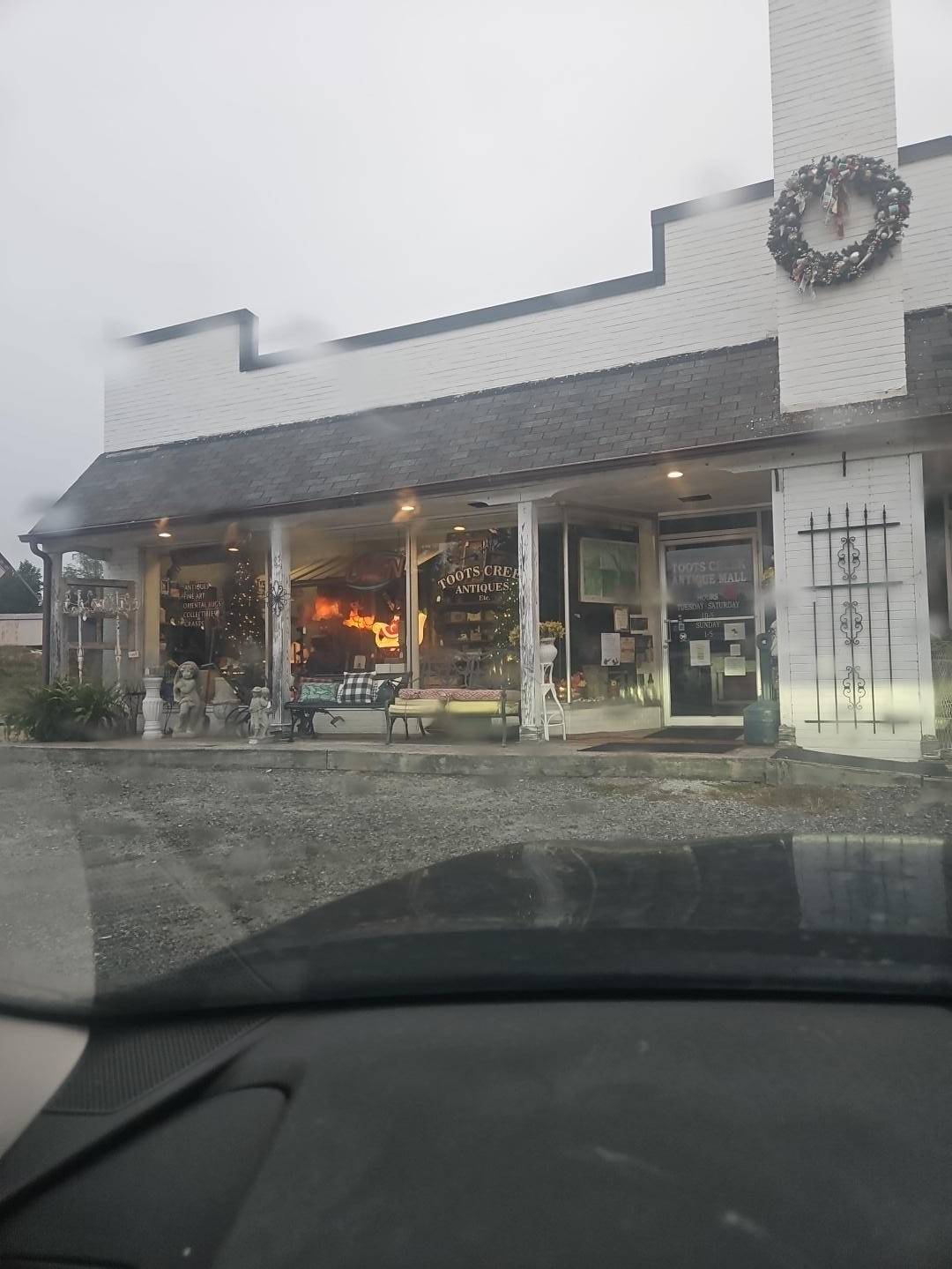
Rainy. Quiet. Not dramatic. The kind of Saturday where a town does not announce itself all at once. It lets you notice it in pieces: a storefront with porch lights on, a wreath on the white siding, a gravel lot shining under the weather, a farmers market sign bright enough to pull your eyes through the drizzle.
I was not there with a formal itinerary. I was on one of my Long Coffee Trips, moving through Halifax, Virginia, letting the day hand me what it had.
Then I saw the antique shop.
The Stop That Tugged
The place was Toots Creek Antiques, and it had the exact kind of rainy-day gravity that makes you slow down even if you are not planning to stop.
Not because every antique shop is automatically magical. Some are mostly dust, lamps, and the faint anxiety of breakable glass. But the good ones have a particular promise. They hold other people's objects long enough for your own memories to start talking back.
From the car, this one had that feeling.
There were lit windows, porch benches, statues, plants, seasonal decorations, and the soft distortion of rain on the windshield. It looked less like an errand and more like a possible return.
The important word there is possible.
Because the first thought was not, "I should make content about this."
The first thought was more human than that:
Kimberly and I might like coming back here.
That is the moment worth saving.
The Market Nearby
Just down the way, the Halifax Farmers Market was open, tucked under its awning with tables, cones, lights, and a few people moving around in the damp morning.
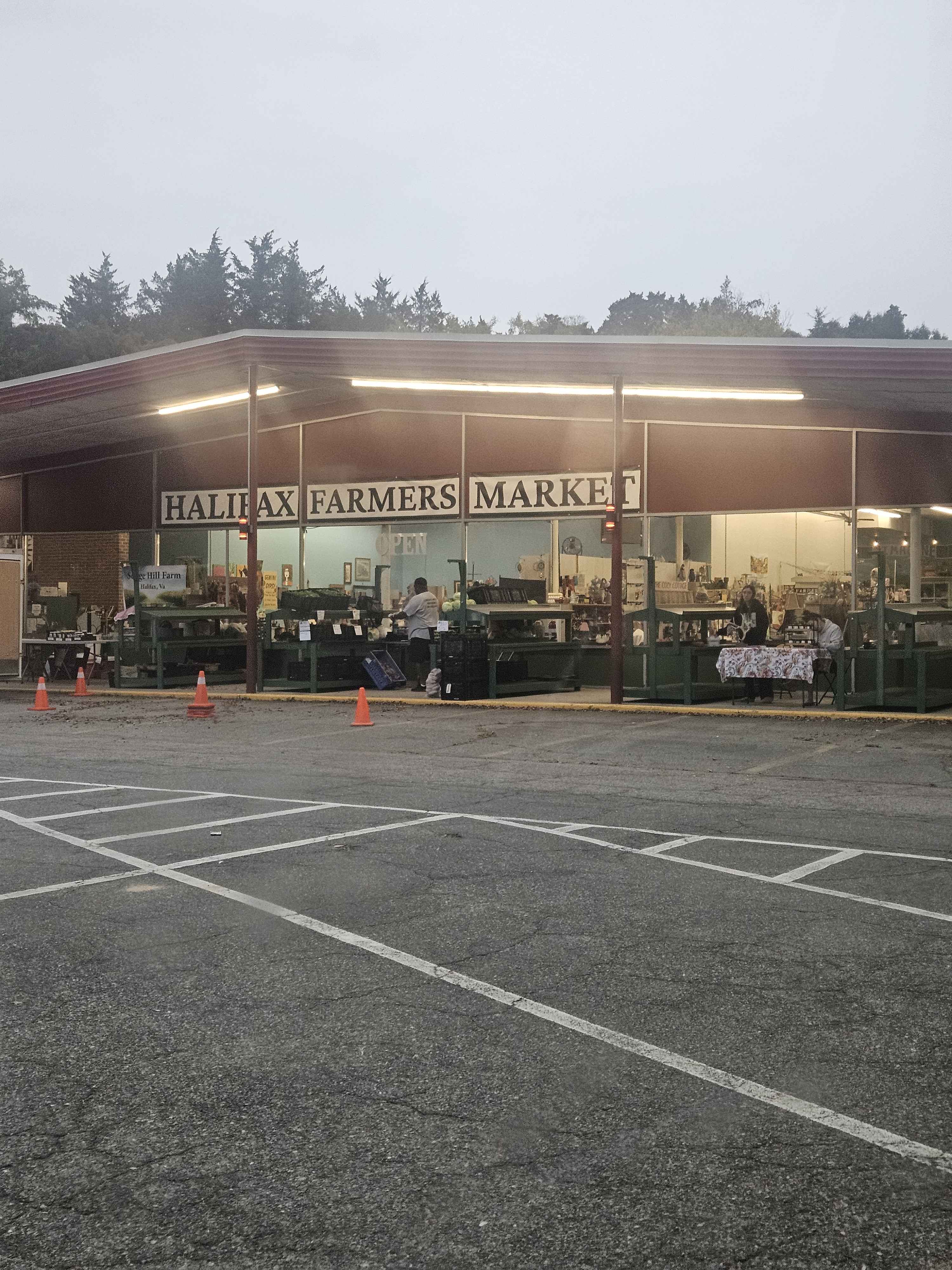
Farmers markets and antique shops make a good small-town pair. One deals in what was grown, baked, canned, cut, arranged, or brought out that morning. The other deals in what lasted long enough to find another life.
Fresh things and old things.
A wet parking lot between them.
That is not a grand travel pitch, exactly. It is better than that. It is a reason to come back when the day is less hurried, or when you are with someone who would notice a different set of details than you did.
This is one of the things I like about third places and day-trip towns. The point is not always the obvious attraction. Sometimes the point is the cluster: the antique mall, the market, the coffee, the bookstore, the street corner, the weather, the mood, the excuse to be somewhere together.
The destination is only part of the trip.
The rest is what the place makes room for.
Why A Photo Is Not Enough
Normally, this is where the modern memory system gets weirdly thin.
I could take a photo of the storefront. I could save a location. I could drop a pin. I could put "Halifax" into a note somewhere and hope future-me remembers why I cared.
But that is a fragile kind of memory.
A photo tells me what the place looked like.
A location tells me where it was.
A timestamp tells me when I was nearby.
None of those automatically preserve the reason it tugged at me.
The reason matters because the reason is what makes the place retrievable in a human way. Six months from now, I am probably not going to ask myself, "What was the exact name of that antique business beside the Halifax Farmers Market?"
I am more likely to ask something messier:
What was that rainy antique place I thought Kimberly might like?
That is a different kind of query. It is not just search. It is memory with intent still attached.
The AI Part, Quietly
This is where the experiment got interesting.
I uploaded the photos into an ongoing conversation with Monica, my AI coach, and talked through what I wanted to remember. I did not just ask for a name. I explained the context: Halifax, rain, Long Coffee Trip, antique shop, nearby farmers market, possible return trip with Kimberly.
The AI could read the signs in the images. It identified Toots Creek Antiques and the Halifax Farmers Market.
That part is useful, but it is not the heart of the story.
The heart is that the conversation captured the why.
The stop mattered because it felt like a return candidate. A small place worth bringing back into the future. A possible shared outing instead of just another image buried in the phone roll.
That is the piece I keep coming back to with personal AI and Second Brain work. The technology is not only useful when it answers questions. It becomes more interesting when it helps preserve the relationships between things: photo, place, person, weather, intention, memory, future plan.
The best version of this does not ask the human to become a database administrator. You should not have to understand embeddings, OCR, APIs, or connector architecture to save a meaningful stop.
You should be able to take the picture and say, "Remember why this mattered."
Places Need Their Reasons
Travel memory can flatten quickly if we only keep the visible evidence.
We remember the sign but lose the mood. We remember the address but lose the impulse. We remember that we saved a place but forget whether it was for food, curiosity, work, a person we love, or a version of ourselves we were trying to pay attention to.
That is a shame because the why is where the place becomes personal.
Third places work that way. They are not just coordinates. They are rooms, porches, counters, markets, benches, sidewalks, and little pockets of public life that become meaningful because something in you responds to them.
Sometimes the response is practical: I could work here for an hour.
Sometimes it is social: this would be a good place to meet someone.
Sometimes it is creative: this place is giving me ideas.
And sometimes it is relational: I want to bring Kimberly here.
That last one is enough. More than enough.
The Field Note I Want Later
The practical future version is simple.
Months from now, I want to be able to ask:
What was that antique shop I saw on a rainy Long Coffee Trip in Halifax, the one near the farmers market?
And I want the answer to come back with more than a business name.
I want it to bring back the scene: the rain, the storefront, the market nearby, the reason I noticed it, and the fact that it felt like a good Kimberly stop.
That is not nostalgia for its own sake. It is useful memory.
It helps a day trip happen instead of disappearing into "we should do that sometime." It turns a passing thought into something I can find again.
This is what I mean when I say a field note can become a memory map. Not a perfect map. Not a surveillance log. Just enough context to help a real human remember what the day was trying to say.
Bring The Why Back With You
The lesson from Halifax is small, but I think it travels.
When a place catches your attention, do not only capture what it looks like. Capture why it caught you.
Say the reason out loud. Write the note. Send the text. Record the messy sentence before it gets polished into nothing.
The antique shop matters because it looked like a place worth returning to.
The farmers market matters because it gave the stop a little ecosystem.
The rain matters because it softened the whole thing and made the lights feel warmer than they probably were.
And the conversation matters because it preserved more than the names on the signs.
That is the promise I am chasing with AI-assisted memory: not replacing the experience, not turning every outing into a productivity exercise, but helping the human bring the right parts of the day back home.
Sometimes a place is worth remembering before you know exactly what it means.
That is why you save it.