Some trips work better when they are not too well explained in advance.
You leave the house with a loose shape of an intention. Coffee, maybe. A bookstore, maybe. A walk. A change of room. A reason to be somewhere other than the same chair, the same screen, the same stack of tabs quietly breeding in the corner of the day.
If someone asks what you are looking for, the honest answer may be: I do not know yet.
That can sound inefficient. It is not how productivity systems usually describe useful work. Useful work is supposed to begin with a defined outcome, a checklist, a destination, a metric.
But a lot of human discovery does not begin that cleanly.
Sometimes the value of going somewhere is not what you went there to find.
It is what you encounter because you went.
The point of leaving
A third place is not magic because it is charming. A bookstore is not useful only because it contains books. A coffee shop is not meaningful because the chair is objectively better than the chair at home.
The point is that these places interrupt the sealed loop.
At home, the day can become too legible. The same objects produce the same assumptions. The same tools invite the same habits. Even good routines can turn into a hallway with no side doors.
Leaving the house creates friction, but it also creates openings. You have to cross a parking lot. You have to notice the weather. You have to stand near other people who are living completely separate stories. You have to look at shelves, counters, sidewalks, bulletin boards, overheard fragments, and small arrangements of attention that were not designed around you.
That matters.
The world is full of prompts that do not look like prompts.
Bookstores are good at this
Bookstores are especially good at unplanned discovery because they reward peripheral vision.
You may walk in looking for one thing and leave thinking about another. A title pulls at you. A table display interrupts your mood. A page opens in the wrong place and makes a sentence feel addressed to the day you are actually having.
That is different from search.
Search is useful when you know the shape of the answer you want. Wandering is useful when you do not yet know the shape of the question.
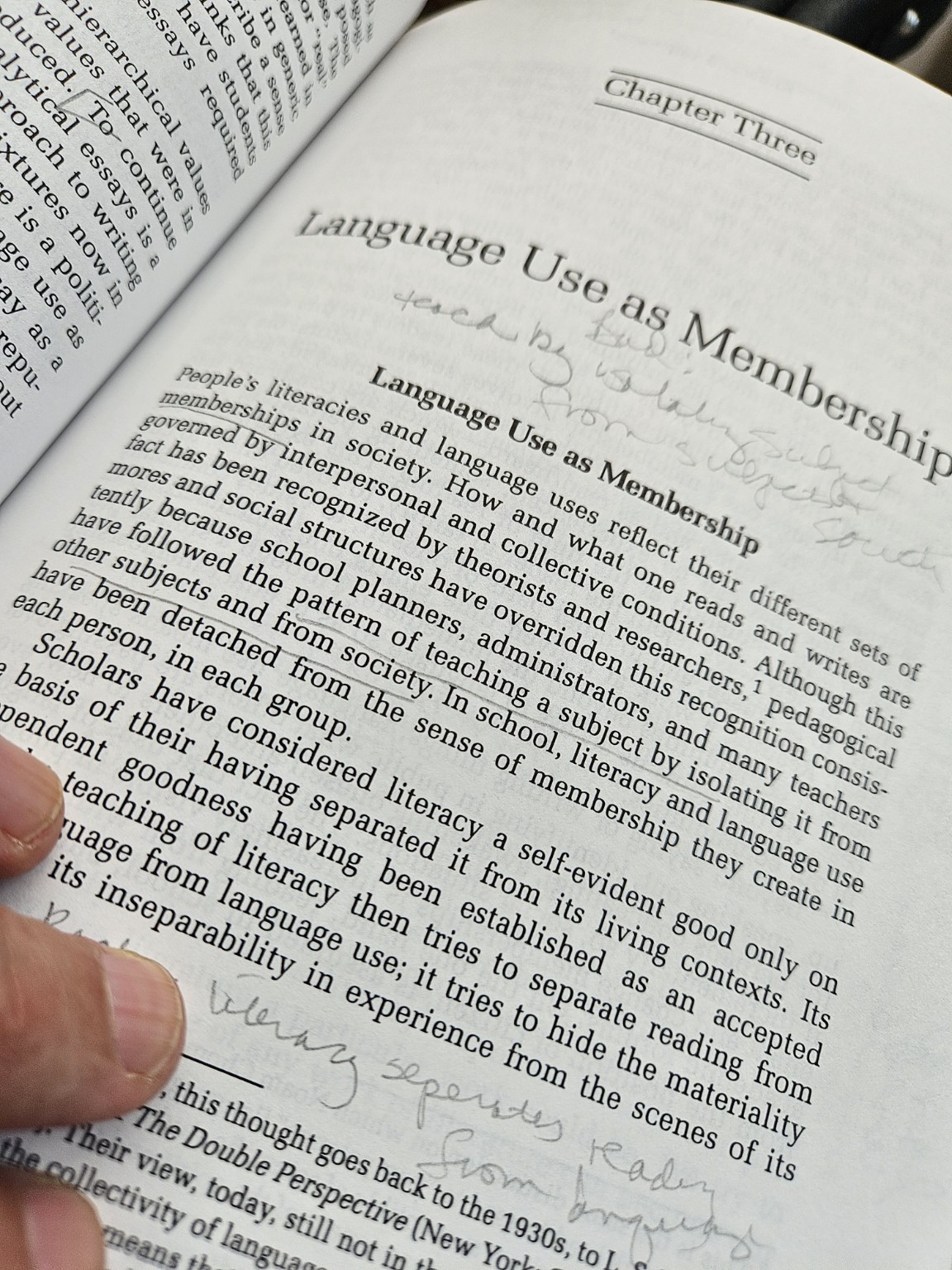
The source image for this piece is simple: an open book chapter with handwritten notes in the margins. I am not going to pretend to know the whole setting, the full book history, or the exact story behind the handwriting. The visible signal is enough.
Someone was physically there with a page.
Someone stopped long enough to mark it.
Someone let an object in the world change the direction of their attention.
That is a small thing. It is also the whole thing.
Not just photos. Signals.
The working phrase for this Long Coffee Trips experiment is:
Not just photos. Signals.
That phrase fits because the photo is not only documentation. It is evidence of contact.
A field photo from a day out can look ordinary if you treat it like content inventory. Open book. Notes. Page. Done.
But the more interesting question is what had to happen before that photo existed.
Somebody had to go somewhere. They had to enter a place where discovery was possible. They had to pick something up, turn pages, linger, notice, react, and decide that this small encounter was worth bringing back.
That chain matters more than the image as decoration.
The image is a receipt from attention.
Serendipity needs a body
Digital discovery is real. A recommendation can be useful. A search result can save an hour. A conversation with AI can help sort out the shape of an idea.
But physical wandering gives serendipity a body.
It gives discovery weight, distance, lighting, weather, noise, smell, and interruption. It asks you to be a person moving through a place, not only a mind requesting an answer.
That difference is easy to underestimate.
When you wander through a third place, you are not only consuming information. You are letting context work on you. You are giving chance more surfaces to touch: a shelf, a cover, a side street, a quiet table, a overheard sentence, the mood of a room, the way a place makes you slow down or keep moving.
You cannot fully plan for that.
You can only create the conditions where it might happen.
The useful kind of inefficiency
This is why aimless time is not always wasted time.
Aimless is not the same as careless. Wandering is not the same as drifting forever. A long coffee trip can still have a center of gravity: get out, look around, notice what feels alive, bring something back.
That is enough structure.
Too much structure can make the day brittle. It can turn every place into a backdrop for a prewritten task. Then the cafe is only a remote office, the bookstore is only a sourcing channel, the walk is only a step count, and the trip is only a content harvest.
That is not what makes these places worth returning to.
The better version is more receptive.
Go somewhere. Pay attention. Do not demand that the world justify itself immediately. Let the day hand you something before you decide what the day was for.
What you bring back
You may come home with a book. You may come home with a photo. You may come home with a sentence, a mood, a question, a small annoyance, a new route, or a reason to return.
You may come home with nothing that looks productive.
Then, a few hours later, you realize the trip loosened something.
The idea that was stuck at home has a different angle now. The project you were forcing has a simpler doorway. The page you photographed becomes a prompt. The place becomes part of the thought.
That is the quiet usefulness of third places.
They do not always give you the thing you thought you were looking for.
They give you encounters.
And sometimes an encounter is better than an answer.
Go anyway
There is a kind of attention that only shows up after the first small act of leaving.
Not a dramatic escape. Not a grand trip. Just enough movement to let the day become less sealed.
Go to the bookstore without needing to know which shelf will matter.
Go to the coffee shop without turning the table into a productivity altar.
Go for the walk without insisting that it pay rent before it begins.
The point is not to romanticize every outing. Some days are just errands. Some cafes are loud in the wrong way. Some trips do not land.
Still, there is a reason to keep making room for physical discovery.
The world keeps offering things that cannot find you while you are sitting still.
Sometimes you have to go somewhere before you can know what you were looking for.